
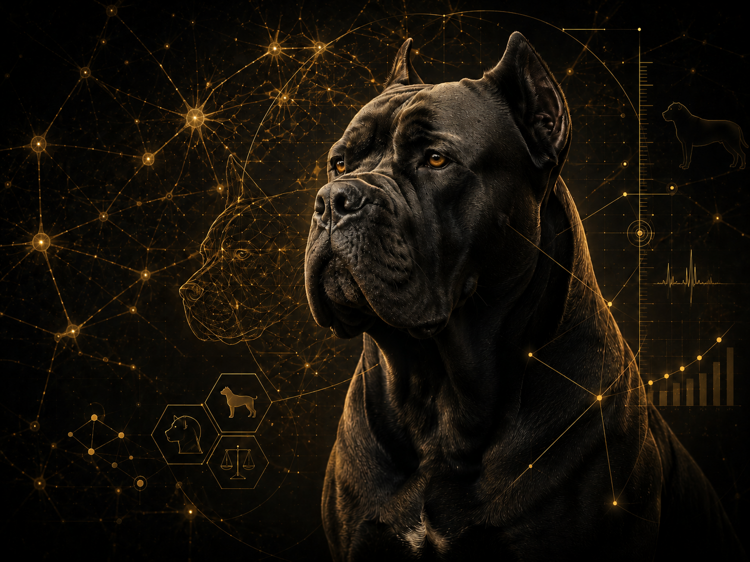
An intelligent layer that helps USG see more clearly
USG Intelligence will not be a magic answer or an automatic judge. It will organize data, photos, and history so owners, admins, and future expert review have more context.
Growth, structure, and change over time
The first practical layer tracks age, sex, weight, height, repeated measurements, and photos.
- growth trends
- missing data
- better measurement and photo guidance
Visual differentiation from close molossoid breeds
A future intelligent visual analysis will support orientation between Cane Corso and similar molossoid lines without issuing an official verdict.
- structure, head, muzzle, proportions, musculature, and movement
- careful comparison with Dogo Argentino, Presa Canario, Mastino Napoletano, Dogue de Bordeaux, Bullmastiff, and other molossoid types
- result as guidance, not proof of origin or breed identity
A stronger base through USG records
Photos, measurements, and history become more valuable when organized over time.
- structured profiles
- better comparison base
- connection between Registry, Visual Atlas, and future analytical tools
Human judgment remains central
The analysis can organize signals and suggest what to check, while important decisions stay human and transparent.
- no automatic Registry or Gallery publishing
- no automatic USG recognition or rejection
- every important result should be explainable
From data to assisted orientation
The platform first collects and organizes information. The intelligent layer analyzes as an assistant. USG then displays results with clear boundaries and human review.
- The owner adds data: age, weight, height, photos, and notes.
- The platform organizes history and change over time.
- The intelligent analysis looks for patterns, gaps, and visual similarities.
- The result is shown as assisted guidance with explanation.
- The owner, admin, or specialist decides the next step.
What this analysis will not be
Not a veterinary diagnosis
Health, emergency, and reproduction questions always require a qualified specialist.
Not an official judgment
It does not replace FCI, clubs, judges, pedigrees, breeding authorities, or standards.
Not automatic truth
Every result depends on quality, angle, light, data, and human context.
A bridge between atlas, data, and history
The Visual Atlas gives knowledge through images. Intelligent analysis adds knowledge through data. The heritage layer adds historical and cultural depth.